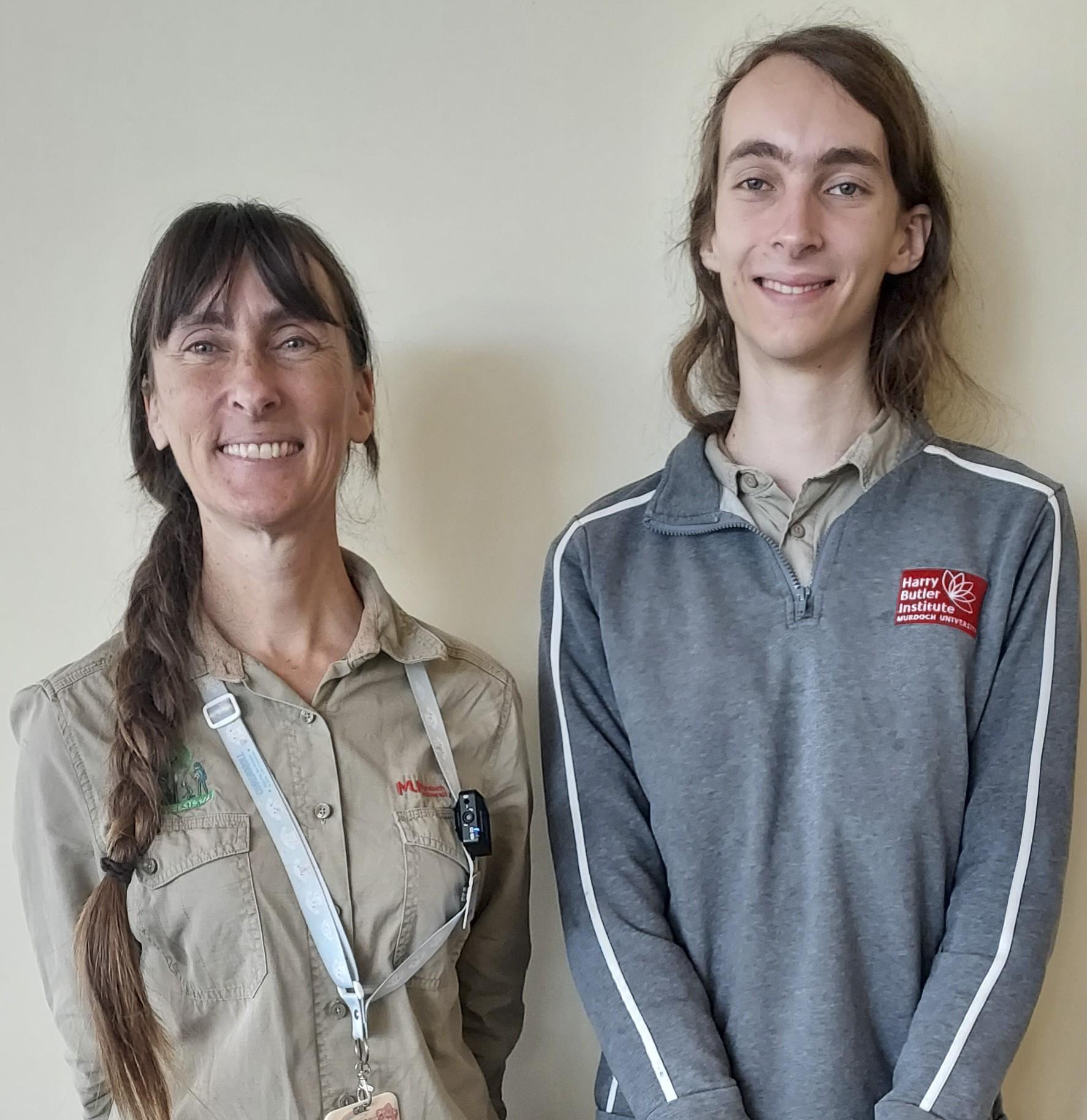
Dr Grey Coupland and colleague Hamish
Dr Grey Coupland from the Harry Butler Institute, based at Murdoch University, was our speaker for Tuesday, 20th October. She was accompanied by her colleague, Hamish.
Grey has been with the Harry Butler Institute since 2021. Her current research looks into the ecology of Miyawaki (pocket) forests and the use of these forests for urban greening in Western Australia.
Grey and Hamish deliver a dedicated STEM outreach program to school students, encouraging them to “green” their environment.
The program is one of 152 programs globally which are recognised as part of the UNESCO Green Citizens initiative and won the Australian Museum Eureka Prize for “Innovation in Citizen Science” in 2026 and also the Premier’s Science Engagement Award the same year.
Grey usually speaks for around an hour and had to condense her important message to 20 minutes, but she covered a lot of ground in a short time.
The first thing we should be aware of is the effects of climate change. Recently we have had four successive heat waves and less rainfall, resulting in tree canopy loss. Trees have been lost to the shot hole borer pest, but far more drastically, to our urban sprawl. Perth covers the biggest area in the world.
Perth also has the dubious distinction of having the lowest tree canopy cover of any city in Australia.
Professor Akira Miyawaki of Japan was the founder of the Miyawaki Forest Program (tiny forest concept). He planted the mini forests across Japan, and took the program to India, where engineer Shubhenda Sharma also saw a need for re-foresting after industrialisation and land clearing.
Generally speaking, a Miyawaki forest is planted over degraded land the size of a tennis court. Three to five plants are placed per square metre. The plants are chosen for their potential national vegetation.
The basic fundamental of a Miyawaki forest is soil remediation. The top soil is removed and replaced with organic compost. This results in plants which mature 10 times faster than normal growth; they are up to 18 times more biodiverse and up to 10 times denser.
Children can contribute to creating a tiny forest from the very start by collecting food scraps from their lunches or supermarkets, and bringing coffee beans and newspapers to make the organic compost required.
When the land is cleared, they help to dig in the plants, mark them with bamboo stakes, water them and watch them grow. The project gives them a sense of community and great satisfaction.
There are 26 Miyawaki forests in WA. There are 20 in Perth schools, where there is plentiful land but not all of it is being utilised. The forests attract invertebrates and 41 species of birds have been recorded as visiting these greening projects.
On a typical summer’s day of 34deg in Perth, temperatures have been recorded in the mini forest of 26deg, the carpark 58deg, and grass at 36deg. The forests have a wonderful natural way of cooling the environment, which has never been more important with land clearing making way for housing estates which have no bushland or space to plant big trees.
Grey has had discussions with the Minister for Housing, and he has visited a Miyawaki forest project. We need many many more of these tiny forests in our city!